A fuel order can look deceptively simple.
A customer needs fuel. An order is created. A truck delivers it.
But anyone working in fuel delivery operations knows how much happens between those three points.
Orders compete for capacity. Trucks have compartments and constraints. Drivers have schedules, certifications and terminal requirements. Routes change. Customers adjust quantities. Delivery priorities move. Equipment becomes unavailable. New orders arrive after the day has already been planned.
And through all of it, the business needs to answer one deceptively difficult question:
What’s happening with this delivery right now?
Visibility is rarely lost all at once.
It usually disappears in the handoffs between different parts of the operation.
And when it does, the impact shows up in more places than dispatch.
More phone calls.
More driver interruptions.
More manual updates.
More time spent hunting for answers.
More chances for different people to be working from different information.
Let’s follow a fuel order from intake through delivery and look at where visibility can break down.
1. Order Intake: The Information Exists, But Who Can Use It?
Everything begins with the order.
Customer.
Location.
Product.
Quantity.
Tank.
Delivery requirements.
Requested timing.
The information may exist somewhere in the business, but that does not automatically mean the people responsible for the next step can use it.
If an order enters one system while dispatch operates in another, something needs to bridge that gap.
Without a reliable connection, that can mean duplicate entry, emails, spreadsheets or verbal communication.
That creates the first potential visibility gap.
The order exists, but it is not yet operationally visible.
The question to ask is simple:
When an order enters your business, how quickly does it become actionable for the people responsible for planning and delivering it?
2. Planning: Seeing an Order Isn’t the Same as Seeing the Operation
Once the order reaches planning, the dispatcher is not simply deciding whether it should be delivered.
They are balancing it against the rest of the operation.
What needs to move today?
What can move tomorrow?
Which truck has the right capacity and compartment configuration?
Which driver is available and qualified for the work?
What other orders can logically be grouped into the trip?
What inventory conditions or customer priorities affect the plan?
What changed since the original plan was created?
This is where visibility has to expand beyond the individual order.
Dispatchers need context.
When that context is spread across systems, spreadsheets, phone calls and people’s heads, planning becomes harder than it needs to be.
The information may technically exist.
But if someone has to hunt for it, it is not providing much operational visibility.
3. Dispatch: The Plan Meets Reality
A perfect plan at 7:00 AM may not survive until 10:00 AM.
That is normal.
A customer changes a quantity.
A driver becomes unavailable.
A truck has an issue.
A priority delivery appears.
A route needs to change.
The important question is what happens to the information when the plan changes.
Imagine a customer changes one order.
That single change could affect:
Order → Load → Truck → Route → Driver → Schedule → Delivery → Customer Visibility
If those parts of the workflow are disconnected, one operational change can create several communication tasks.
Someone updates the order.
Someone tells dispatch.
Dispatch adjusts the plan.
Someone tells the driver.
Someone else updates another system.
Customer service may still be looking at the original information.
The operational change happened once.
The information surrounding it may need to change in several places.
That is a visibility problem.
4. Delivery Execution: What Happens After the Truck Leaves?
This is one of the most important transitions in the workflow.
The plan leaves the office and becomes a physical delivery.
At this point, many operations experience another visibility gap.
The dispatcher knows what was supposed to happen.
But what is actually happening?
Has the driver started the route?
Where is the truck?
Has the driver arrived?
Has loading or unloading started?
Has the delivery been completed?
Is the delivery running late?
Has something changed?
When office teams have limited access to execution information, the driver’s phone can become the tracking system.
If the fastest way to understand what is happening with a delivery is to call the driver, the business does not really have operational visibility.
It has a communication process.
That is not ideal for the driver or the office.
Drivers need to focus on executing deliveries safely and accurately.
Dispatchers need enough information to manage the broader operation without constantly interrupting drivers for status updates.
The information generated in the field needs to move back into the operational workflow.
5. Customer Service: “Where’s My Delivery?”
Now the phone rings.
A customer wants an update.
This is where internal visibility becomes customer experience.
If the person answering the customer has enough information available, the conversation can be straightforward.
If they do not, another chain begins.
Customer calls customer service.
Customer service calls dispatch.
Dispatch checks the plan.
Dispatch may call the driver.
The answer travels back to customer service.
Customer service responds to the customer.
A simple question has now involved multiple people.
Multiply that by every status request throughout the day and visibility becomes more than an information problem.
It becomes a labor problem.
The issue is not that the customer asked for an update.
The issue is that the answer was not visible where it was needed.
Operational visibility is not only a dispatch issue.
It affects the entire organization.
6. Delivery Completion: The Truck Arrived. Is the Workflow Finished?
The fuel has been delivered.
Operationally, the physical job may be complete.
Digitally, there may still be work to do.
Delivery information needs to return to the business.
Records may need to be updated.
Exceptions may need attention.
Billing may require delivery information.
Customers may need confirmation.
Management may need the data for reporting.
If completion simply starts another manual chain of emails, calls or data entry, the workflow is not really complete.
The final step in visibility is making sure what happened in the field becomes available to the people and processes that come next.
The Common Thread: Handoffs
Look at each of these visibility gaps and a pattern appears.
They tend to happen at transitions.
Order Intake → Planning
Planning → Dispatch
Dispatch → Driver
Driver → Delivery
Delivery → Office
The individual systems involved may work perfectly well.
The problem appears when the work moves from one stage to another but the information does not move with it.
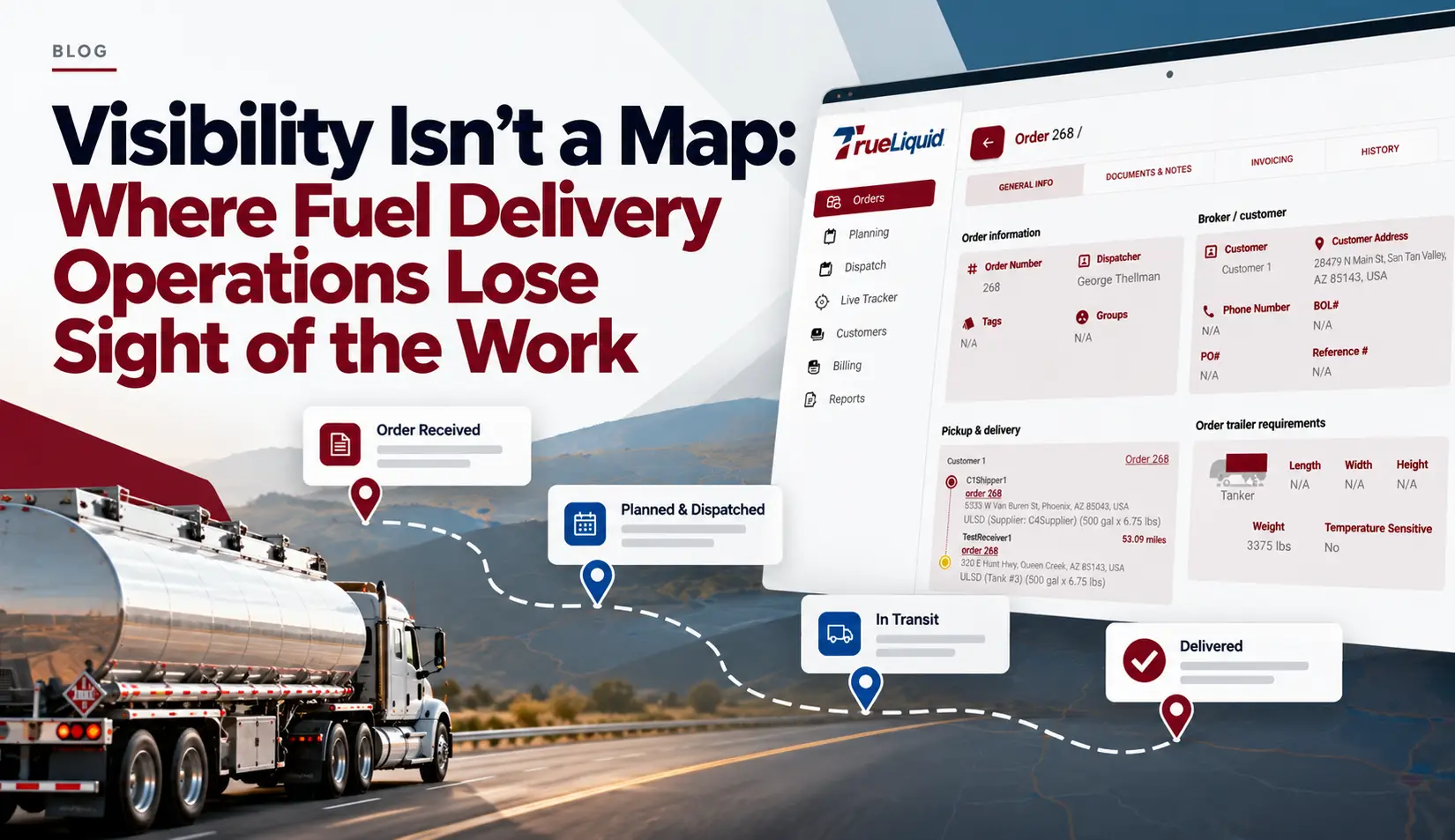
That is why operational visibility cannot simply mean putting dots on a map.
Knowing where a truck is can be valuable.
But location is only one piece of the operational picture.
Real visibility means understanding the delivery in context.
What order is this?
What was planned?
Who is executing it?
What has changed?
What has been completed?
What needs attention?
What happens next?
Visibility Isn’t a Screen. It’s a Connected Workflow.
It is tempting to think about visibility as a dashboard.
Open the dashboard. Look at the operation. Now you have visibility.
But a dashboard can only show the information available to it.
If the workflow feeding that dashboard is fragmented, the visibility will be fragmented too.
A more useful way to think about visibility is as the result of connected operations.
Order Intake
↓
Planning & Dispatch
↓
Delivery Execution
↓
Visibility
Each stage creates information the next stage needs.
And information generated later in the workflow needs to travel back to the people managing the operation.
That is what makes visibility actionable.
Find Your Visibility Gaps
You do not need a major technology project to start identifying where visibility breaks down.
Take one real delivery from your operation and reconstruct its journey.
Ask:
Where did the order originate?
Where was it entered?
How did dispatch receive it?
What information did the dispatcher need from somewhere else?
How was the driver given the plan?
How did the office know the delivery was progressing?
What happened when something changed?
How was completion communicated?
How many phone calls were required?
How many systems were opened?
How many times was the same information entered?
How many spreadsheets were involved?
Every unnecessary handoff is worth investigating.
Individually, these gaps can look small.
Across an entire fuel delivery operation, every day, they become something much bigger.
Connect the Work, Not Just the Technology
TrueLiquid is built around the way fuel delivery operations actually move.
Order Intake → Planning & Dispatch → Delivery Execution → Visibility
The objective is simple: help the information surrounding a delivery move with the delivery itself.
So when something changes, the operation can respond.
When customer service needs an answer, the information is easier to find.
When dispatch needs to understand what is happening in the field, the driver does not have to become the tracking system.
And when management needs a clearer picture of the operation, the information is connected to the work that produced it.
Because better visibility is not about watching more screens.
It is about connecting the work happening behind them.
If your team still has to call drivers, check multiple systems or chase dispatch for delivery status, let’s walk through one of your real delivery workflows.
In 20 minutes, we can look at where visibility breaks down today and whether TrueLiquid can help connect the operation from order intake through delivery execution.
Schedule a 20-minute conversation with TrueTMS.